

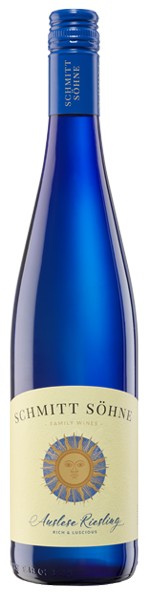
 Schmitt Söhne
Riesling Auslese
Mosel, Germany
NECTAR WINE STYLE
This Auslese (selected harvest) Riesling is produced from grapes that remain on the vine until extremely late in the year. Individually selected overripe grapes result in a full-bodied, luscious wine with hints of apricot, nectarine and honey. It has intense flavors and a lingering finish.
Analysis: 8.5-9% alcohol / volume
Variety: Riesling
Appellation: Mosel, Germany
RS: 52-56 g/L
TA: 8-9 g/L
Pairing Recommendation: Enjoy with cheeses, fruits, richly seasoned foods and desserts. Or enjoy as a wine cocktail or sipping after a memorable dinner.
Serve: Chilled
WineStyles’ Wine and Cheese Pairing: A perfect cheese pairing for this wine would be Gorgonzola Dolce. Gorgonzola Dolce is a creamy, slightly sweet blue cheese that balances the wine’s sweetness with its mild tang, while the creaminess complements the wine’s rich texture. The fruitiness of the Riesling will also contrast beautifully with the savory elements of the cheese. Learn more about our wine and cheese pairings here.
Winemaking: Auslese is picked at ultimate ripeness, sometimes two months after harvest season has started. This allows the fruit flavors to develop and ripen. During picking, the grapes are handled very carefully to avoid bruising, letting the natural sweetness shine through. Harvested in the cool early morning, the grapes are brought quickly to the winery, destemmed and placed in stainless steel tanks that help retain the Riesling’s crisp acidity. The wine is kept cool, between 50-65 ºF, during fermentation.
Vineyards:
Schmitt Söhne Auslese Riesling hails from select vineyards along the Mosel River in Germany. Mosel is regarded as the oldest wine-growing region in Germany, believed to have been established by the Romans around 50 AD. It is one of the most northernly wine regions in world. Mosel vineyards are famous for their steep south-facing slopes and blue slate soil, reflected in the balanced minerality of Schmitt Söhne’s Auslese Riesling.
About Schmitt Söhne Wines:
Family-owned and operated, over 200 years ago the Schmitt ancestors settled in the small village of Longuich, along the Mosel River, and began managing vineyards and producing wine. Now in the fifth generation, Schmitt Söhne is one of Germany’s largest and most successful wine exporters around the world. While they have continued to develop their winemaking techniques and technologies, the family has never lost sight of their traditions. Learn more here.
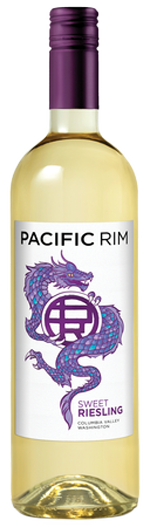 Pacific Rim
Sweet Riesling
Columbia Valley, Washington
NECTAR WINE STYLE
This wine is wonderfully aromatic with notes of honey, pear and orange blossom. On the palate, it is sweet, with bright acidity, pineapple and white peach.
Analysis: 8% alcohol / volume
Variety: 100% Riesling
Appellation: Columbia Valley, Washington
RS: 73.3 g/L
TA: 7.2 g/L
Pairing Recommendation: Ideal with fiery fare – especially Thai, Szechwan, Mexican, Middle Eastern, and Caribbean cuisine. Or enjoy with one of their suggested recipes >
WineStyles’ Wine and Cheese Pairing: Sweet wines from our ‘Nectar’ section pair well with an herbal cheese, such as a gorgonzola. Learn more about our wine and cheese pairings here.
PRODUCTION:
The winery picks their Riesling grapes early (20-21 Brix). Using only native yeasts and fermenting at low temperatures in stainless steel tanks – there is no use of oak barrels or malolactic fermentation. They stop the fermentation at about 7% residual sugar, and clean the wine rapidly to retain as much freshness and fruitiness as possible. They leave a fair amount of natural carbon dioxide in the wine to create a lively mouth feel.
ABOUT THE WINERY:
First released by Randall Grahm of Bonny Doon Vineyard in 1992, Pacific Rim Dry Riesling quickly gained a loyal following among Riesling lovers. Known for its fresh and bright characteristics, the wine was a welcome alternative to over-oaked, one-dimensional white wines. As the American palate evolved in recent years toward wines with greater complexity and crisper acidity, the popularity of Pacific Rim Dry Riesling grew. Demand and enthusiasm for Pacific Rim Dry Riesling continued to gain momentum — and the excitement around the wine inspired a radical idea… the creation a winery exclusively dedicated to Riesling. In August of 2006, a small band of Bonny Doon expats moved to the Northwest from California with a common desire to craft the best Riesling in America… thus, Pacific Rim became its own winery. Learn more about the winery here.
Photo and Information courtesy of © Pacific Rim – All Rights Reserved
 Love the Sweet life?
 WineStyles Tasting Station